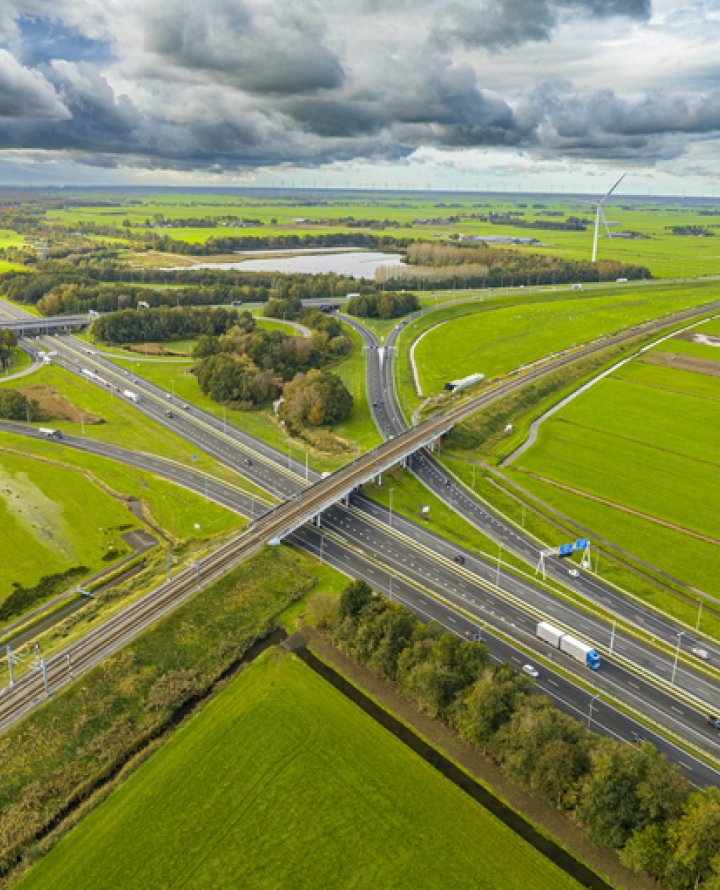
Various transport options are available today, all of which have their advantages and disadvantages. Seamlessly connecting forms of transport (modalities) can provide an almost imperceptible and noiseless transport system that flexibly, cheaply, and sustainably supplies the world's population with its need to move people and goods at any time and under any circumstances. Although this is a global, or at least European, issue, the Netherlands plays a special role in this field because of our wide variety of transport options. In addition, there are important new technical developments, such as self-driving cars, chain control facilities and other advanced technology that are going to influence mobility issues for people and goods. Intelligent travel information will take off, and the balance between transport modes will change. This demand therefore encompasses several aspects: smart infrastructure and means of transport, high-quality direction of the entire transport chain through advanced algorithms, and providing decision-makers with the right ICT support.
Connecting character
The transport of people and goods is increasingly seen as an integrated system, in which the various transport options influence each other, and in which the robustness of the system depends, among other things, on the available variety of transport options. Fundamental science challenges lie in modelling and analysing this integral transport system. Applied and design research are needed to develop control mechanisms on that system, both for people and goods. Another important scientific challenge involves the development of new transport options, such as self-driving cars, but also the relocation of production due to 3D printing. These questions are partly technical, but partly also social, moral and legal. The functioning of our society depends heavily on the mobility of people and goods and the optimal synchronisation of different flows. As such, this question also has an important social component. This involves, for instance, the environmental burden of traffic and transport and solving traffic jams, but also developments towards the further individualisation of public transport, managing the balance between different transport options and controlling energy consumption in transport. Our mobility needs cost a lot of money. Costs are compounded by lost time due to traffic jams, negative health effects from emissions and other nuisances, and other costs such as damage and loss of goods. Research should lead to reducing these costs while maintaining an acceptable level of mobility. There are also opportunities in marketing the knowledge we gain on how to further develop our mobility system.